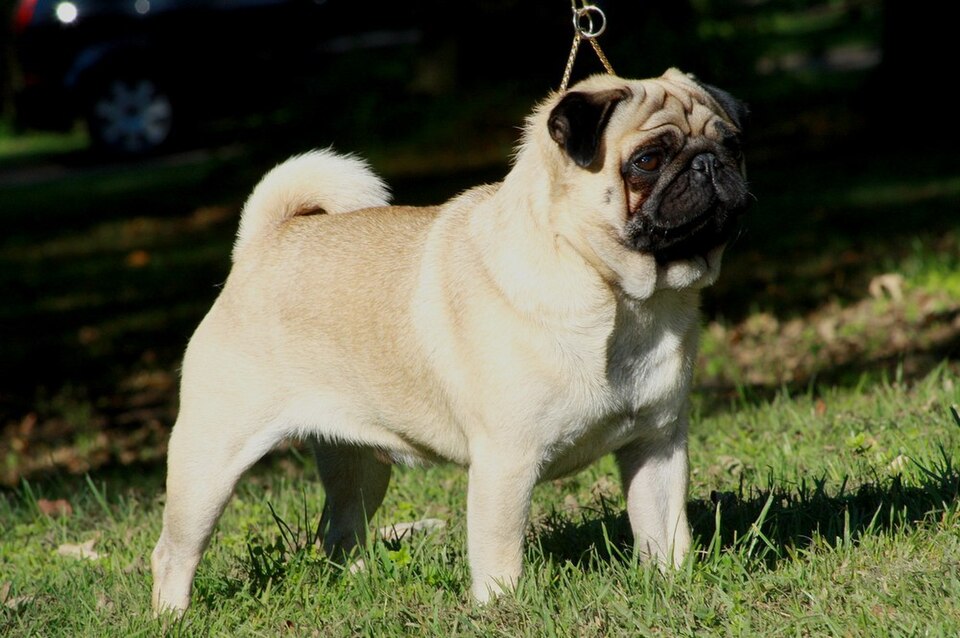
Pugs cannot breathe like a normal dog, and in the largest UK vet-record study of the breed they were found about 54 times more likely to be diagnosed with obstructed breathing than other dogs, on top of being far more prone to eye ulcers and obesity.
11.6years, median
0.9 years below the all-dog median of 12.5.
Measured, not estimated: the middle age at death across 584,734 UK dogs, 284,734 of them deceased. Based on 12,808 dogs of this breed. 95% confidence interval 11.4 to 11.8 years. Half lived longer than this, half did not. UK dogs, so treat it as the best available figure rather than a promise about yours.
In the same study, small breeds as a group had a median of 12.7 years and flat-faced breeds 11.2. This breed is small and flat-faced.
McMillan et al. 2024, Scientific Reports 14:531 — open access · CC BY 4.068.19% of Pugs had at least one disorder recorded in 2013.
From the clinical records of 1,009 Pugs under veterinary care in the UK that year, read by the Royal Veterinary College’s VetCompass programme.
Most often recorded, 2013
| Disorder | Share of Pugs | 95% CI |
|---|---|---|
| Overweight or obese | 13.18% | 11.12–15.43 |
| Corneal disorder | 8.72% | 7.05–10.63 |
| Ear infection (otitis externa) | 7.53% | 5.98–9.34 |
| Ear disorder, unspecified | 7.43% | 5.89–9.23 |
| Anal sac impaction | 6.54% | 5.09–8.25 |
| Gum disease (periodontal disease) | 6.14% | 4.74–7.81 |
| Overgrown nails | 5.65% | 4.31–7.26 |
| Obstructed breathing (BOAS) | 5.15% | 3.87–6.70 |
| Vomiting | 4.96% | 3.70–6.48 |
| Diarrhea | 3.77% | 2.69–5.13 |
Compared with other dogs, 2016
4,308 Pugs against 21,835 other dogs. The odds of having at least one disorder that year were 1.86 times those of other dogs (95% CI 1.72 to 2.01). Of 40 disorders tested, 23 were more common in the breed and 7 less common.
More likely in Pugs — times the odds
- Obstructed breathing (BOAS)6.6% vs 0.1%54×
- Narrowed nostrils (stenotic nares)2.7% vs 0.0%51×
- Corneal ulcer6.8% vs 0.7%13×
- Skin fold dermatitis2.3% vs 0.2%11×
- Ear discharge1.8% vs 0.2%9.6×
- Allergic skin disease1.6% vs 0.3%5.9×
- Demodex mange1.7% vs 0.2%5.6×
- Retained baby teeth5.5% vs 1%4.3×
- Obesity17.4% vs 6.9%3.9×
- Umbilical hernia4.6% vs 0.9%3.7×
- Eye discharge1.9% vs 0.7%2.5×
- Overgrown nails11.8% vs 5.5%2.5×
- Undescended testicle2.1% vs 0.6%2.5×
- Slipping kneecap (patellar luxation)2.2% vs 1%2.3×
- Anal sac impaction8.8% vs 4.8%2.2×
- Hair loss (alopecia)1.7% vs 0.8%2.2×
- Ear infection (otitis externa)12.9% vs 7.2%2.0×
- Coughing1.6% vs 1%1.9×
- Wound problem after surgery2.3% vs 1.2%1.8×
- Skin infection (pyoderma)2% vs 1.4%1.6×
- Vomiting4.5% vs 3.1%1.4×
- Conjunctivitis2.9% vs 2.2%1.3×
- Diarrhea5% vs 3.8%1.2×
Less likely
- Heart murmur0.3% vs 2.2%0.23×
- Fatty lump (lipoma)0.1% vs 1.5%0.24×
- Aggression0.6% vs 2.2%0.31×
- Wound1% vs 1.8%0.53×
- Swallowed object (foreign body)0.9% vs 1.3%0.62×
- Claw injury0.8% vs 1.4%0.64×
- Lameness1.6% vs 2.6%0.66×
Neither Pug paper reports age at death. The measured-lifespan figure above is from a separate 2024 study.
“the Pug has diverged substantially from mainstream dog breeds and can no longer be considered as a typical dog from a health perspective.”— the authors, O'Neill et al. 2022, Canine Medicine and Genetics 9:4
Health tests to ask the breeder for
Pug Dog Club of America sets the tests a Pug needs for a CHIC number in the OFA's open database. A CHIC number means the tests were done and the results are public. It does not mean the dog passed them: ask for the results for both parents, or look them up yourself on ofa.org.
- Pug Dog Encephalitis (PDE) DNA marker test
- Eye Examination by a boarded ACVO Ophthalmologist
- Patellar Luxation (OFA Evaluation)
When to spay or neuter a Pug: the UC Davis study of 35 breeds has a suggested guideline for the breed. For males it is any age. For females, any age. The spay and neuter page has the numbers behind it and what the guidelines say for a dog this size.
Eye ulcers: in a study of more than 100,000 dogs in England, about 1 Pug in 18 had one in a single year, over 19 times the risk of a crossbred dog. A squint or a half-closed eye is a same-day call to the vet. The eye ulcer page has the signs, and the eye drops that make an ulcer worse.
- Hip Dysplasia (OFA Evaluation)
- Elbow Dysplasia (OFA Evaluation)
- Pyruvate Kinase Deficiency (PK Def) DNA test
- Serum bile acid test (puppies)
- OFA Spine evaluation (hemivertebrae)
- Tracheal Hypoplasia (OFA radiographic evaluation)
- Cardiac Evaluation (Advanced or Basic Cardiac Exam)
Test names as the club lists them; checked September 2026. OFA CHIC breed page. How to use this at the breeder: check a breeder.
Adopt a Pug near you
Shelters and rescues list Pugs and Pug mixes on Petfinder. Enter a ZIP code to see who is waiting within 100 miles.
Listings come from Petfinder and open there. Petipedia does not take part in adoptions and earns nothing from them.
Living with a Pug
Pugs are affectionate, food-motivated, low-exercise dogs that fit small homes and less active owners well on paper, but daily life means watching heat and humidity closely since heatstroke is a real risk, keeping weight down in a breed naturally prone to obesity, cleaning facial wrinkles to prevent skin infections, and accepting that snoring, snorting, and labored breathing after normal activity are just how this breed is, not a sign something is wrong that one vet visit will fix.
Health you should know about
- Brachycephalic obstructive airway syndrome (BOAS) — the shortened muzzle and narrowed airway cause snoring, snorting, and breathing distress that worsens in heat or with exercise; a UK veterinary-record study of over 4,000 Pugs found them about 54 times more likely to be diagnosed with BOAS than non-Pugs, and separate respiratory-grading research found only around 7% of Pugs assessed had fully normal, unobstructed breathing.
- Corneal ulceration and eye injury — the same UK study found 6.8% of Pugs affected by corneal ulceration versus 0.7% of other breeds, about 13 times the odds; shallow eye sockets and prominent eyes mean scratches, ulcers, and in severe cases the eye popping out of its socket are real risks.
- Obesity — found in 17.4% of Pugs in the same study versus 6.9% of other breeds, especially dangerous in a breed that already struggles to breathe and regulate its temperature.
- Skin fold dermatitis and narrowed nostrils (stenotic nares) — both significantly more common in Pugs than in other breeds, and both make breathing and skin health worse.
Read the full Dog Care Guide first — costs, daily time, and everything a dog needs before you choose a breed.
Naming a Pug? Chinese and Tibetan dog names, 79 of them, with what they mean.
Sources — 4 references
Last reviewed October 2026. 4 sources listed below. Written and maintained by Petdeals.io. General care information, not veterinary advice — for a sick animal, call a vet.