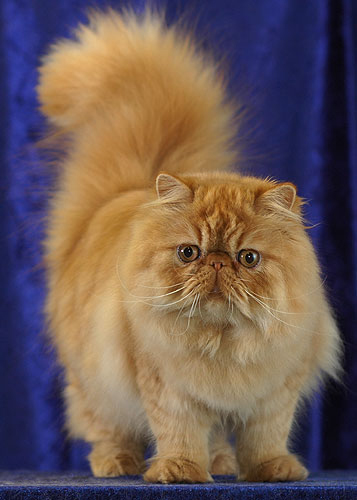
The flat 'doll face' that wins in the show ring is extreme brachycephaly by another name, and it comes with lifelong breathing difficulty, constant tear overflow, and a kidney disease that historically affected roughly a third to half of the breed before genetic screening became common.
10.93years, life expectancy at birth
0.8 years below the all-cat life expectancy at birth of 11.74.
Measured, not estimated: worked out from 7,936 UK cats that died in 2019 under veterinary care. Based on 80 deaths of this breed. 95% confidence interval 9.63 to 12.23 years. Life expectancy at birth is the average a kitten of this breed could expect; a cat that is already an adult has a longer expected total, because it has got past the risky early years. UK cats, so treat it as the best available figure rather than a promise about yours.
Teng et al. 2024, Journal of Feline Medicine and Surgery 26(5) — open access · figures cited with attribution64.9% of Persians had at least one disorder recorded in 2013.
From the clinical records of 3,235 Persians under veterinary care in the UK that year, read by the Royal Veterinary College’s VetCompass programme.
Most often recorded, 2013
| Disorder | Share of Persians | 95% CI |
|---|---|---|
| Coat disorder (matting and the like) | 12.7% | 11.6–13.9 |
| Gum disease (periodontal disease) | 11.3% | 10.2–12.4 |
| Overgrown nails | 7.2% | 6.3–8.1 |
| Eye discharge | 5.8% | 5.0–6.7 |
| Heart murmur | 5.8% | 5.0–6.7 |
| Flea infestation | 5.1% | 4.4–5.9 |
| Weight loss | 4.9% | 4.2–5.8 |
| Conjunctivitis | 4.5% | 3.8–5.3 |
| Diarrhea | 4.4% | 3.7–5.2 |
| Vomiting | 4.3% | 3.7–5.1 |
Any eye problem, grouped: 15.3% (95% CI 14.1 to 16.6).
Age at death in this sample
Median 13.5 years (middle half 9.9 to 16), 2013 data. Of the 435 deaths with a recorded cause: Kidney disease 23.4%, Cancer (neoplasia) 8.5%, Lump (mass) 8%, Collapse 6.2%, Appetite problem 5.7%, Underweight 4.8%, Traumatic injury 4.4%. Females 14.0 years, males 13.1. Different sample and year from the measured lifespan above, which is why the two numbers differ.
Coat problems ran at 12.7% against 2.5% in non-pedigree cats. Kidney disease caused 23.4% of deaths, against 13.6% in cats generally aged five and over.
“this study highlights the need for increased owner awareness to manage and prevent the typical health problems associated with this breed's phenotype.”— the authors, O'Neill et al. 2019, Scientific Reports 9:12952
Health tests to ask the breeder for
There is no CHIC program for cats. These are the DNA and screening tests that the testing laboratories and cat health bodies name for the Persian. A breeder who tests will show the certificates; a DNA result of "clear" for one variant is not a guarantee against the disease.
- PKD1 DNA test (UC Davis VGL / Langford Vets) screens for autosomal-dominant polycystic kidney disease
- PRA-pd (AIPL1) DNA test (UC Davis VGL / Langford 'Persian PRA') screens for early-onset progressive retinal atrophy
- Echocardiogram (heart ultrasound) by a veterinary cardiologist, repeated regularly for breeding cats screens for hypertrophic cardiomyopathy (HCM); no DNA test covers this breed (GCCF and Cornell list the Persian as HCM-predisposed)
When to spay or neuter: by five months, whatever the breed. That is the one answer the AVMA, the feline practitioners and AAHA all give, and the spay and neuter page has why, and the two weeks after.
Eye ulcers: in cats they usually come from the herpes virus, and Persians are among the breeds most prone to a sequestrum, a patch of cornea that dies and turns dark. Steroid eye drops can set the virus off again. The eye ulcer page has the signs and what to ask the vet.
Sources: vgl.ucdavis.edu · vgl.ucdavis.edu · langfordvets.co.uk · gccfcats.org. Checked September 2026. Check a breeder has the questions.
Adopt a Persian near you
Shelters and rescues list Persians and Persian mixes on Petfinder. Enter a ZIP code to see who is waiting within 100 miles.
Listings come from Petfinder and open there. Petipedia does not take part in adoptions and earns nothing from them.
Living with a Persian
Persians are calm, undemanding homebodies who would rather sit in your lap than climb anything, but that easy personality sits inside a body that needs daily brushing to prevent matting, regular face-wiping for tear stains, and a vet on speed-dial for breathing or eye flare-ups. This is a high-maintenance body wrapped in a low-maintenance personality, and buyers who only budget for the coat are usually the ones surprised by the vet bills.
Health you should know about
- Brachycephalic Obstructive Airway Syndrome (BOAS) — narrowed nostrils and an elongated soft palate make normal breathing effortful; International Cat Care notes breathing difficulty can be severe in the flattest-faced individuals and worsens with heat or exertion.
- Chronic tear overflow and corneal disease — the flattened face distorts the tear ducts so eyes water and stain constantly, while shallow eye sockets leave the cornea more exposed to scratches, ulcers, and sequestrum.
- Polycystic kidney disease (PKD) — a dominantly inherited disease in which fluid-filled cysts slowly destroy kidney tissue; UC Davis estimates historically over 37% of Persians carried it, and separate multi-country studies put overall prevalence around 36-49%, though ultrasound and DNA screening have been cutting that rate in tested lines since the mid-2000s.
- Increased risk of dystocia (difficult birth) — the same head and pelvis shape linked to brachycephaly is also associated with a higher rate of birthing complications requiring veterinary intervention.
Read the full Cat Care Guide first — costs, daily time, and everything a cat needs before you choose a breed.
Naming a Persian? Persian cat names, 80 of them, with what they mean.
Sources — 5 references
Last reviewed October 2026. 5 sources listed below. Written and maintained by Petdeals.io. General care information, not veterinary advice — for a sick animal, call a vet.