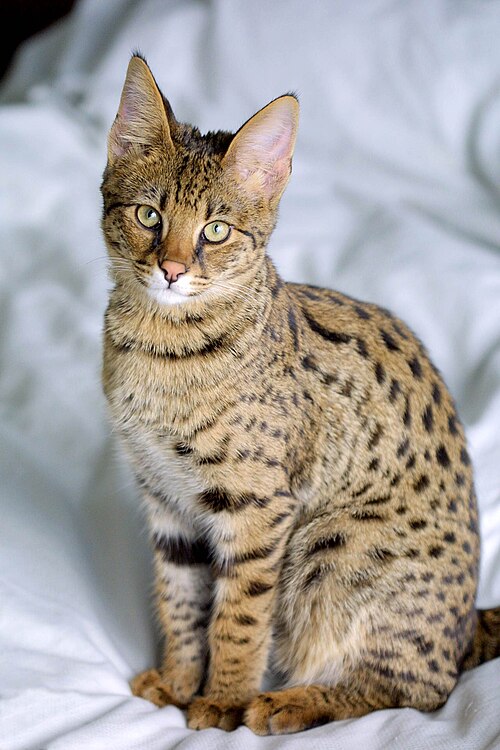
A Savannah is a serval hybrid, and how legal it is to own one depends entirely on the generation (F1 being closest to the wild serval, F5 and later being fully domestic under TICA's standard) and on your specific state and city — some places ban the breed outright, some allow only F4/F5, and a cat that's legal to own in your state can still be banned in your city, so buyers must verify both before they buy, not after.
Health tests to ask the breeder for
There is no CHIC program for cats. These are the DNA and screening tests that the testing laboratories and cat health bodies name for the Savannah. A breeder who tests will show the certificates; a DNA result of "clear" for one variant is not a guarantee against the disease.
- Bengal PRA-b DNA test (UC Davis VGL lists Savannah among affected breeds) screens for early-onset PRA
- Erythrocyte Pyruvate Kinase (PK) Deficiency DNA test (UC Davis VGL / Langford Vets) screens for inherited haemolytic anaemia
- PRA-rdAc (CEP290) DNA test (UC Davis VGL / Langford Vets) screens for late-onset progressive retinal atrophy / blindness
When to spay or neuter: by five months, whatever the breed. That is the one answer the AVMA, the feline practitioners and AAHA all give, and the spay and neuter page has why, and the two weeks after.
Sources: vgl.ucdavis.edu · vgl.ucdavis.edu · vgl.ucdavis.edu · langfordvets.co.uk. Checked September 2026. Check a breeder has the questions.
Adopt a Savannah near you
Shelters and rescues list Savannahs and Savannah mixes on Petfinder. Enter a ZIP code to see who is waiting within 100 miles.
Listings come from Petfinder and open there. Petipedia does not take part in adoptions and earns nothing from them.
Living with a Savannah
Early-generation Savannahs (F1-F3) are genuinely closer to wild in behavior — highly active, prone to marking, and capable of jumping and destruction a typical house cat won't attempt; roughly 90% of Savannah surrenders are attributed to failed litter-box training. Later generations (F4/F5) behave much more like an unusually large, athletic domestic cat, but even then this is a high-energy breed that needs serious daily enrichment, not a couch companion — and many individuals genuinely enjoy water play.
Health you should know about
- Hypertrophic cardiomyopathy (HCM) — the Savannah Cat Association notes the breed is more prone to it than other domestic breeds and recommends cardiac screening of breeding cats.
- Progressive retinal atrophy and pyruvate kinase deficiency — both are recommended screening tests for breeding Savannahs, per the breed association.
- Male infertility in early generations — F1 through roughly F4 males are typically sterile, a direct consequence of hybridizing across species; only F5-and-later males are reliably fertile.
Read the full Cat Care Guide first — costs, daily time, and everything a cat needs before you choose a breed.
Sources — 3 references
Last reviewed October 2026. 3 sources listed below. Written and maintained by Petdeals.io. General care information, not veterinary advice — for a sick animal, call a vet.