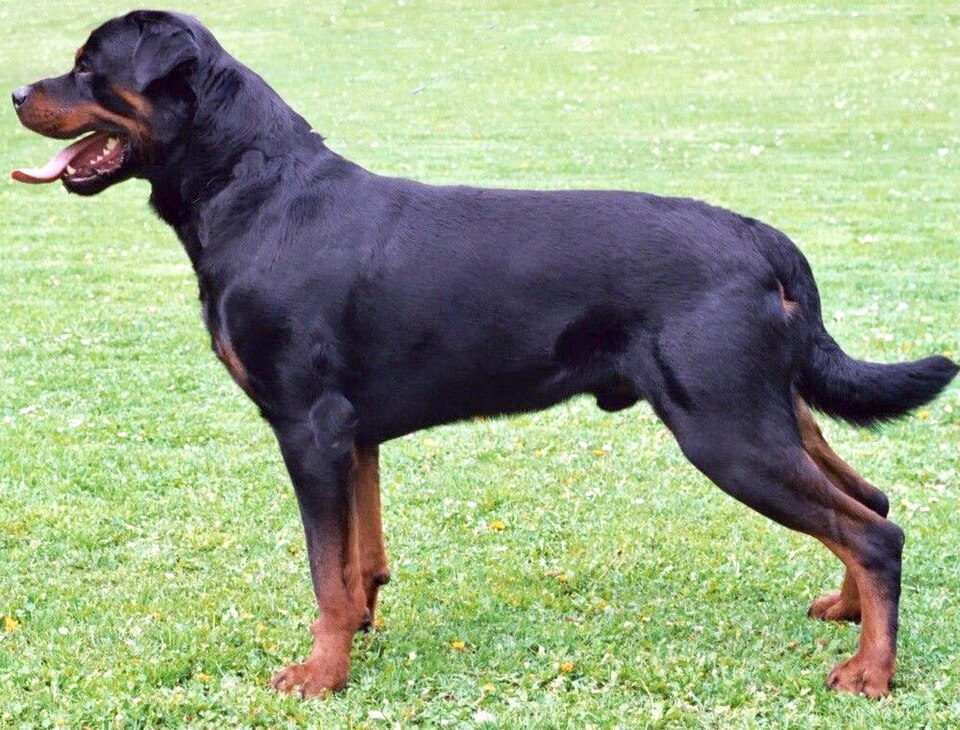
Rottweilers carry one of the highest bone-cancer risks of any breed — a UK veterinary study found them roughly 27 times more likely to develop osteosarcoma than crossbred dogs — and their size and guarding instinct mean home insurance restrictions and breed-specific legislation are a real practical concern most breeds don't face.
10.6years, median
1.9 years below the all-dog median of 12.5.
Measured, not estimated: the middle age at death across 584,734 UK dogs, 284,734 of them deceased. Based on 9,717 dogs of this breed. 95% confidence interval 10.4 to 10.7 years. Half lived longer than this, half did not. UK dogs, so treat it as the best available figure rather than a promise about yours.
In the same study, large breeds as a group had a median of 11.9 years and medium-muzzled breeds 12.8. This breed is large and medium-muzzled.
McMillan et al. 2024, Scientific Reports 14:531 — open access · CC BY 4.060.31% of Rottweilers had at least one disorder recorded in 2013.
From the clinical records of 2,197 Rottweilers under veterinary care in the UK that year, read by the Royal Veterinary College’s VetCompass programme.
Most often recorded, 2013
| Disorder | Share of Rottweilers | 95% CI |
|---|---|---|
| Aggression | 7.46% | 6.40–8.64 |
| Overweight or obese | 7.06% | 6.02–8.21 |
| Ear infection (otitis externa) | 6.14% | 5.18–7.23 |
| Arthritis (degenerative joint disease) | 4.69% | 3.84–5.66 |
| Diarrhea | 3.5% | 2.78–4.36 |
| Dental disease | 3.05% | 2.37–3.86 |
| Overgrown nails | 3.05% | 2.37–3.86 |
| Hot spots | 2.91% | 2.25–3.70 |
| Cruciate ligament disease | 2.32% | 1.73–3.04 |
| Anal sac impaction | 1.82% | 1.30–2.47 |
Age at death in this sample
Median 9 years (middle half 7.2 to 10.5), 2013 data. Of the 312 deaths with a recorded cause: Cancer (neoplasia) 33%, Unable to stand 16%, Lump (mass) 7.1%, Gut disease 6.1%, Brain disorder 4.2%, Undesirable behavior 4.2%, Muscle, bone or joint disorder 3.8%. Females 9.5 years, males 8.7. Different sample and year from the measured lifespan above, which is why the two numbers differ.
One death in three with a recorded cause was cancer. Aggression was recorded in 9.36% of males against 5.47% of females.
“Rottweilers appear relatively short-lived and cancer constitutes a frequent mortality cause, warranting consideration of osteosarcoma screening in elderly dogs presenting with lameness.”— the authors, O'Neill et al. 2017, Canine Genetics and Epidemiology 4:13
Health tests to ask the breeder for
American Rottweiler Club sets the tests a Rottweiler needs for a CHIC number in the OFA's open database. A CHIC number means the tests were done and the results are public. It does not mean the dog passed them: ask for the results for both parents, or look them up yourself on ofa.org.
- Hip Dysplasia (OFA Evaluation, 24 months or older)
- Elbow Dysplasia (OFA Evaluation, 24 months or older; results released for public review)
- Cardiac Evaluation ('Cardiac Normal' at 24 months or older, recorded with OFA)
- Eye Examination by a boarded ACVO Ophthalmologist (OFA CAER, 24 months or older)
- Juvenile Laryngeal Paralysis & Polyneuropathy (JLPP) DNA test (at least one parent clear)
When to spay or neuter a Rottweiler: the UC Davis study of 35 breeds has a suggested guideline for the breed. For males it is a year or later. For females, 6 months or later. The spay and neuter page has the numbers behind it and what the guidelines say for a dog this size.
- Cardiologist certification / echocardiogram (recommended beyond the basic cardiac exam)
Test names as the club lists them; checked September 2026. OFA CHIC breed page. How to use this at the breeder: check a breeder.
Adopt a Rottweiler near you
Shelters and rescues list Rottweilers and Rottweiler mixes on Petfinder. Enter a ZIP code to see who is waiting within 100 miles.
Listings come from Petfinder and open there. Petipedia does not take part in adoptions and earns nothing from them.
Living with a Rottweiler
Rottweilers are calm, confident, and genuinely devoted to their family — not the indiscriminately aggressive dog their reputation suggests — but they are large, strong, and naturally protective, and need serious early socialization and training so that instinct doesn't turn into reactivity toward strangers or other dogs. They need consistent daily exercise, and owners should budget for the real possibility of a cancer diagnosis in mid-life along with higher liability or home-insurance costs some providers attach to the breed.
Health you should know about
- Osteosarcoma (bone cancer) — a VetCompass case-control study found Rottweilers about 27 times more likely to develop it than crossbred dogs; it's a leading cause of death in the breed and generally requires amputation and chemotherapy for any chance of extending life.
- Hip and elbow dysplasia — joint malformation common in large, fast-growing breeds; screening of breeding stock is standard practice.
- Gastric dilatation-volvulus (bloat) — a sudden, life-threatening emergency more likely in large, deep-chested dogs like Rottweilers.
- Subaortic stenosis — an inherited narrowing near the heart valve that can cause exercise intolerance, fainting, or sudden death, found at above-average rates in the breed.
Read the full Dog Care Guide first — costs, daily time, and everything a dog needs before you choose a breed.
Naming a Rottweiler? German dog and cat names, 88 of them, with what they mean.
Sources — 4 references
Last reviewed October 2026. 4 sources listed below. Written and maintained by Petdeals.io. General care information, not veterinary advice — for a sick animal, call a vet.