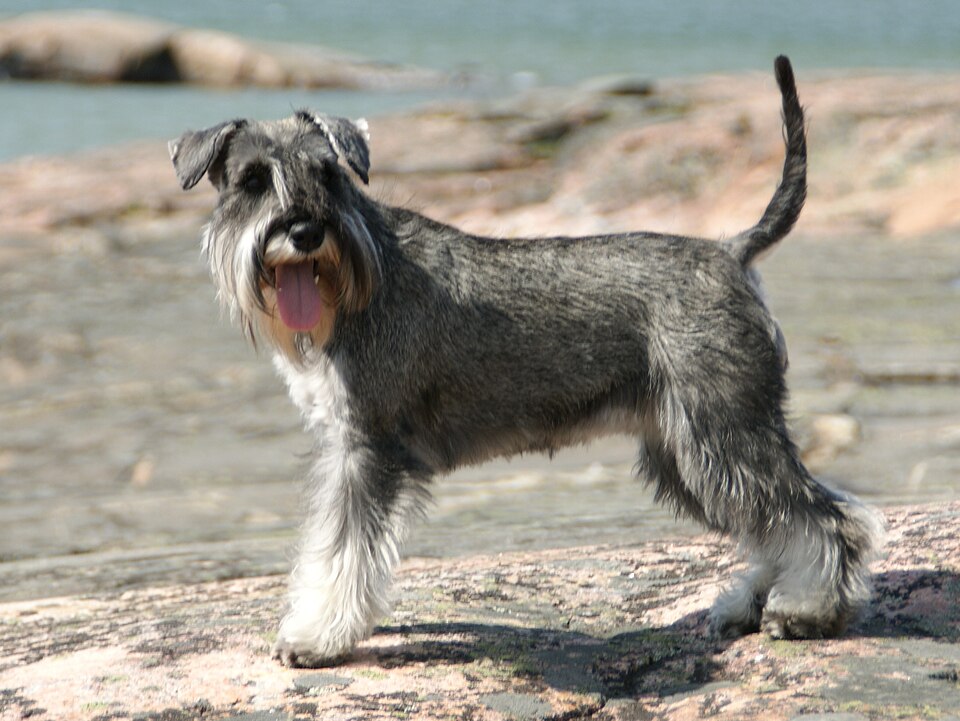
Miniature Schnauzers are unusually prone to forming bladder stones and to pancreatitis, and both are directly linked to diet and body fat — meaning what and how much this small breed eats matters more than in most dogs, not less, despite the size suggesting otherwise.
13.3years, median
0.8 years above the all-dog median of 12.5.
Measured, not estimated: the middle age at death across 584,734 UK dogs, 284,734 of them deceased. Based on 9,670 dogs of this breed. 95% confidence interval 13.2 to 13.5 years. Half lived longer than this, half did not. UK dogs, so treat it as the best available figure rather than a promise about yours.
In the same study, small breeds as a group had a median of 12.7 years and medium-muzzled breeds 12.8. This breed is small and medium-muzzled.
McMillan et al. 2024, Scientific Reports 14:531 — open access · CC BY 4.068.2% of Miniature Schnauzers had at least one disorder recorded in 2013.
From the clinical records of 1,972 Miniature Schnauzers under veterinary care in the UK that year, read by the Royal Veterinary College’s VetCompass programme.
Most often recorded, 2013
| Disorder | Share of Miniature Schnauzers | 95% CI |
|---|---|---|
| Gum disease (periodontal disease) | 17.4% | 15.7–19.1 |
| Overweight or obese | 8.3% | 7.1–9.6 |
| Anal sac impaction | 5.8% | 4.8–6.9 |
| Vomiting | 5.1% | 4.1–6.1 |
| Ear infection (otitis externa) | 5% | 4.1–6.1 |
| Ear disorder | 4.9% | 4.0–6.0 |
| Heart murmur | 4.2% | 3.3–5.1 |
| Diarrhea | 3.4% | 2.7–4.4 |
| Skin mass | 3.2% | 2.5–4.1 |
| Undesirable behavior | 2.6% | 2.0–3.4 |
Age at death in this sample
Median 11.6 years (middle half 9.3 to 13.1), 2013 data. Of the 75 deaths with a recorded cause: Cancer (neoplasia) 14.7%, Collapse 13.3%, Lump (mass) 10.7%, Brain disorder 10.7%, Kidney disease 8%, Gut disease 6.7%. Different sample and year from the measured lifespan above, which is why the two numbers differ.
Females were recorded with gum disease (19.6% against 15.4%), obesity (10.2% against 6.4%) and heart murmurs (5.5% against 2.9%) more often than males.
“This is similar to the median longevity of 12.0 years across all breeds that has been previously reported using a similar method.”— the authors, O'Neill et al. 2019, Canine Genetics and Epidemiology 6:1
Health tests to ask the breeder for
American Miniature Schnauzer Club sets the tests a Miniature Schnauzer needs for a CHIC number in the OFA's open database. A CHIC number means the tests were done and the results are public. It does not mean the dog passed them: ask for the results for both parents, or look them up yourself on ofa.org.
- Eye Examination by a boarded ACVO Ophthalmologist (annually; results registered with OFA)
- Cardiac Evaluation (Congenital Cardiac Exam by a cardiologist, Advanced Cardiac Exam, or Basic Cardiac Exam by a cardiologist)
When to spay or neuter a Miniature Schnauzer: the UC Davis study of 35 breeds has a suggested guideline for the breed. For males it is any age. For females, any age. The spay and neuter page has the numbers behind it and what the guidelines say for a dog this size.
- Myotonia Congenita (Schnauzer type) DNA test
- Mycobacterium Avium Complex (MAC) susceptibility DNA test
- Progressive Retinal Atrophy Type B (HIVEP3) DNA test
Test names as the club lists them; checked September 2026. OFA CHIC breed page. How to use this at the breeder: check a breeder.
Adopt a Miniature Schnauzer near you
Shelters and rescues list Miniature Schnauzers and Miniature Schnauzer mixes on Petfinder. Enter a ZIP code to see who is waiting within 100 miles.
Listings come from Petfinder and open there. Petipedia does not take part in adoptions and earns nothing from them.
Living with a Miniature Schnauzer
Schnauzers are alert, feisty, and genuinely enjoy having a job — training and puzzle toys go a long way. The wiry coat needs professional clipping roughly every 6-8 weeks (it doesn't shed the way most dogs' coats do, which suits allergy-sensitive households but isn't a low-cost trait), and given the breed's stone and pancreatitis risk, table scraps and fatty treats are a worse idea here than for most dogs.
Health you should know about
- Calcium oxalate bladder stones — the breed is well documented in veterinary literature as over-represented for this specific stone type, which can require surgery and tends to recur; diet management is a lifelong consideration.
- Pancreatitis — Miniature Schnauzers are considered predisposed, often linked to fatty food and elevated blood lipids; severity ranges from mild to life-threatening.
- Hyperlipidemia — elevated blood fats are common in the breed and are tied to both the pancreatitis and bladder-stone risk above.
- Progressive retinal atrophy and cataracts — inherited eye diseases documented in the breed that can lead to vision loss.
Read the full Dog Care Guide first — costs, daily time, and everything a dog needs before you choose a breed.
Naming a Miniature Schnauzer? German dog and cat names, 88 of them, with what they mean.
Sources — 4 references
Last reviewed October 2026. 4 sources listed below. Written and maintained by Petdeals.io. General care information, not veterinary advice — for a sick animal, call a vet.